Peripheral Nerve Injuries: A Medicolegal Guide for Instructing Solicitors
By Mr Dean Boyce, Consultant Plastic, Hand and Peripheral Nerve Surgeon
Posted 28 September 2026
10 Minute Read
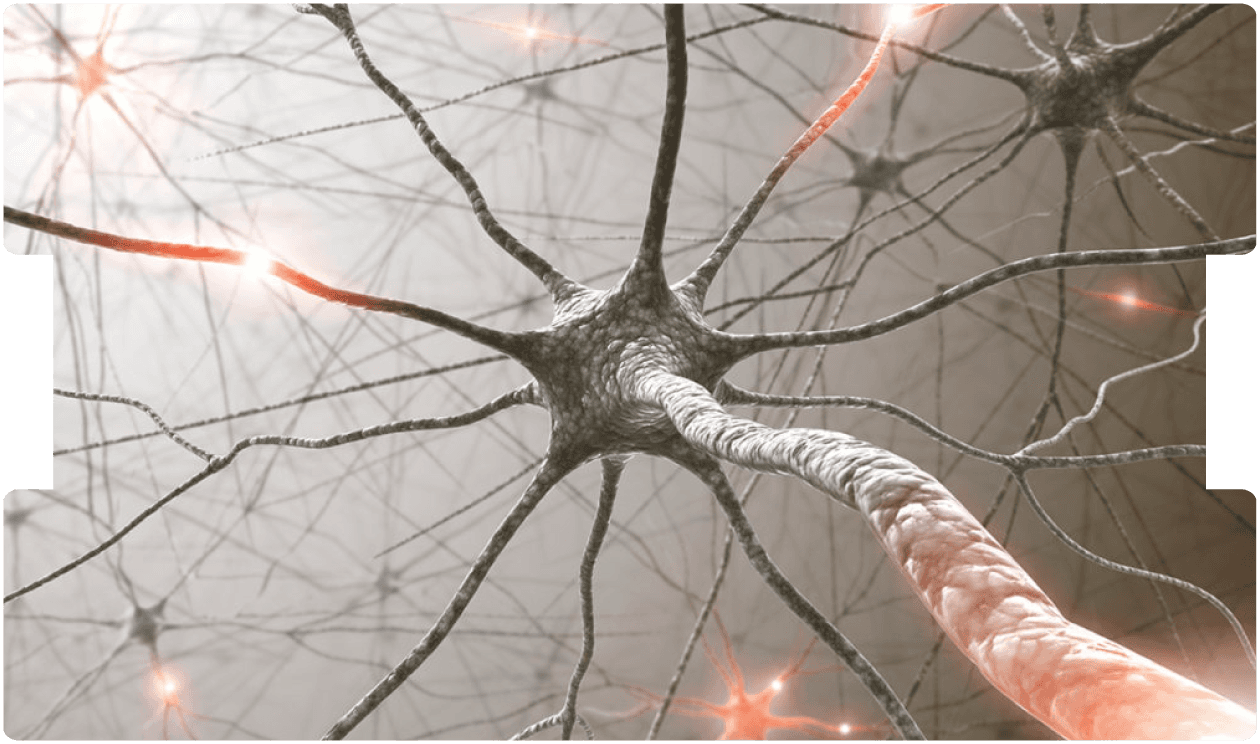
Could settling a peripheral nerve injury claim too early leave significant future losses overlooked?
Peripheral nerve injury claims are among the most technically demanding cases in personal injury and clinical negligence litigation. Claims are frequently settled before the nerve has had a realistic opportunity to recover, prognosis reports are prepared on incomplete evidence, and schedules of loss routinely fail to reflect the claimant's true long-term needs. At the same time, genuine medical uncertainty is regularly exploited by defendants seeking to minimise the value of injuries that may have ended careers and altered claimants' lives permanently.
This guidance sets out the medical framework that legal teams should understand before instructing an expert, and the questions that should be put to that expert once instructed.
Anatomy Determines Everything
The starting point in any nerve injury case is precise identification of the nerve involved and the level at which it has been damaged. This single fact determines the likely functional deficit, the realistic prognosis, the appropriate timing of surgical intervention, and the overall shape of the claimant's long-term losses.
In upper limb cases, an injury to the brachial plexus represents the most severe type of injury, most commonly sustained during road traffic accidents, particularly motorbike and cycling injuries. The C5, 6,7,8 and T1 nerve roots exit the spinal cord, join, divide and and rejoin many times as they travel behind the collar bone to the shoulder region. The brachial plexus continues into the arm as 3 major nerves, the median, ulnar, and radial nerves. In the lower limb, the nerves originate from the lumbar plexus which is within the abdominal cavity, and is so much less commonly injured. Its main continuation in the leg is the sciatic nerve, which may be at risk during hip replacement surgery. The nerve continues down the back of the thigh divides above the level of the knee into the common peroneal and tibial nerves. Injury to each individual nerve carries its own distinct clinical picture.
From a litigation perspective, anatomical localisation of nerve injury matters because two claimants with apparently similar diagnoses may have very different functional and financial consequences. Solicitors should ensure that the expert addresses not only the name of the injured nerve, but the specific functions lost, whether those losses are likely to persist and how they affect the claimant's work, mobility, independence and day-to-day activities. These functional consequences will often be more important to quantum than the diagnostic label alone.
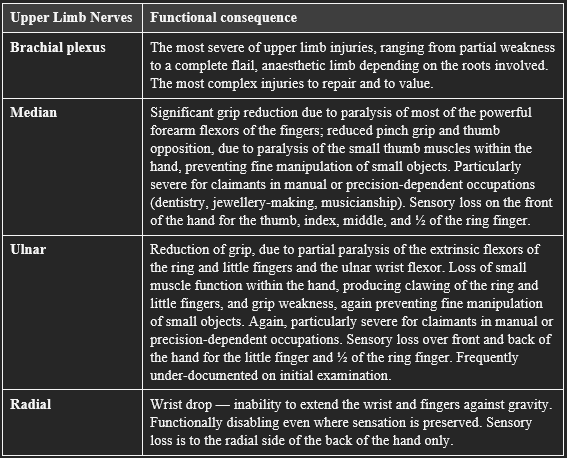
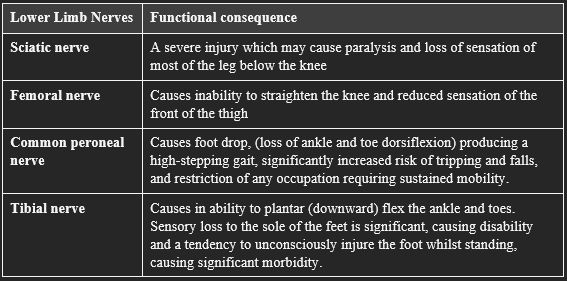
When taking instructions, it can be useful to test these deficits against the claimant's actual pre-injury life rather than relying solely on broad descriptions such as "reduced grip" or "foot drop". A loss of fine hand function may have very different consequences for a surgeon, mechanic or musician than for someone whose work does not depend on dexterity. Likewise, foot drop may affect employment, driving, recreational activities, falls risk and the need for orthotic support. These issues may justify additional evidence from occupational therapy, pain medicine, care, employment or rehabilitation experts depending on the circumstances of the case.
Classification Systems and their Limitations
Nerve injury classification is based which aspect of the nerve’s internal anatomy is injured, and the severity of the injury (See figure below). Trauma may be caused by laceration, but also by crush or traction, where the continuity of the nerve is preserved. Internal scarring caused by crush or traction injury will prevent nerve regeneration. Where continuity is maintained, predicting the level of injury and therefore prognosis is not straightforward. Nerve expert reports will routinely refer to the Seddon and Sunderland classifications, in which nerve injury severity ranges from a temporary conduction block through to complete anatomical division.
THE INTERNAL STRUCTURE OF A PERIPHERAL NERVE:
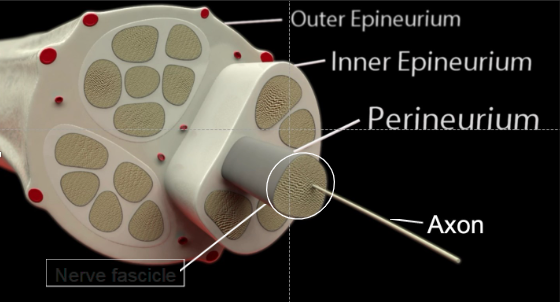
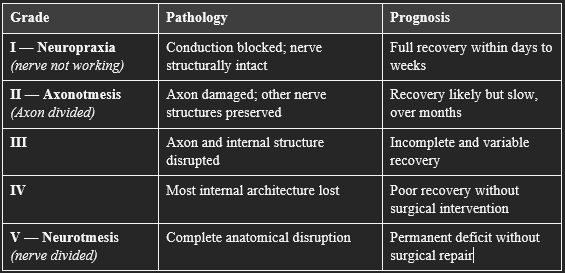
These frameworks are necessary but insufficient on their own. Most clinically significant closed injuries are mix of grades e.g. one fascicle within a nerve may correspond to a Grade II injury while another corresponds to a Grade IV. A single classification applied uniformly to the whole nerve is a simplification that defence experts may exploit where the claimant's expert has committed to a precise grade on insufficient evidence.
Practice point: Classification should be supported by electrodiagnostic evidence (nerve conduction studies and EMG), imaging (MRI and/or ultrasound), and detailed clinical findings. A defence classification of Grade I or II based on a brief examination without electrodiagnostic workup should be challenged. Neurophysiology will provide valuable prognostic advice.
Solicitors should be cautious where an expert report presents a nerve injury grade as a fixed conclusion without explaining the evidential basis for it. Useful follow-up questions include: what investigations support the classification; whether different parts of the nerve may have sustained injuries of differing severity; whether the classification may change as recovery evolves; and what degree of uncertainty remains around prognosis. A seemingly technical disagreement over classification can have significant consequences for future treatment, residual disability and valuation.
Where opposing experts disagree, the issue should not simply become "Grade II versus Grade IV". The more useful medico-legal question is what each interpretation means for the claimant: the anticipated extent and timescale of recovery, likelihood of surgery, degree of permanent disability and impact on future care and employment.
Timing: The Case Against Early Settlement
Peripheral nerves regenerate at approximately one millimetre per day, roughly two to three centimetres per month. A nerve injured at the level of the upper arm may need to regenerate thirty to forty centimetres to reach the muscle it supplies, a process that can take two to three years. Until regeneration is complete, the final functional deficit cannot reliably be determined.
Settlement of a serious nerve injury claim at twelve months post-injury is, in most cases, premature, since regeneration is typically still ongoing. Settlements reached at eighteen months, with the claimant classified as having a permanent significant deficit, may in practice be followed by substantially greater recovery than predicted by the time of trial, producing an unwarranted windfall for the defendant. The converse also occurs early, optimistic prognoses can understate the permanence of the damage.
The most appropriate course is to await the completion of nerve regeneration before finalising prognosis. Where litigation timetables do not permit this, any prognosis report produced early must clearly flag the residual uncertainty and specify the point at which reassessment should occur.
Before considering settlement, solicitors may therefore wish to ask expressly whether the expert regards the prognosis as final. If not, the report should ideally identify what further recovery remains possible, what objective markers will demonstrate whether recovery has plateaued, and when reassessment should take place. Without that information, there is a risk that both the schedule of loss and any settlement proposal are being built around a prognosis that remains provisional.
This is particularly important when evaluating future loss of earnings, care, treatment and equipment. Where future function remains uncertain, solicitors should be wary of converting a provisional medical picture into definitive lifetime assumptions. Conversely, evidence of poor or stalled recovery may support the need to investigate permanent occupational disadvantage, assistance with domestic tasks and long-term rehabilitation needs.
Surgical Negligence: What the Records May or May Not Show
Where the allegation is that a nerve injury resulted from negligent surgery, the following lines of enquiry should be addressed by the instructed expert and pursued by the legal team where the records are silent.
- Nerve identification and protection. The operative note should document that the relevant nerve was identified and safely retracted. In anatomically difficult regions - the axilla, the groin, the popliteal fossa - positive documentation of nerve identification is expected practice, and its absence is itself significant. Where the nerve is at risk, documentation that steps were to be taken to minimise this risk is helpful
- Duration of tension or compression. Nerve injury can result from prolonged retraction or compression alone, without any direct cutting. The type, position, and duration of retractor use should be established, as these are unlikely to have been dicumented.
- Use of diathermy near the nerve. Electrosurgical injury is a recognised mechanism of nerve damage; heat conducted along tissue planes can injure a nerve several millimetres from the point of application. Where diathermy was used near the nerve's expected course, this warrants scrutiny.
- Patient positioning. Intraoperative compression injury - particularly to the ulnar nerve at the elbow and the common peroneal nerve at the fibular head - is a commonly overlooked cause of nerve damage. Theatre records should document positioning, padding, and whether position was checked during prolonged procedures.
- Recognition and response. A nerve divided intraoperatively should ordinarily be repaired immediately by a surgeon competent to do so. Delay in recognition, or failure to obtain appropriate assistance or advice, can materially worsen the outcome.
For the legal team, the operative note should not be considered in isolation. Depending on the allegation, relevant evidence may include the consent documentation, anaesthetic chart, theatre checklist, positioning records, implant or equipment records, postoperative neurological observations and records of any subsequent referral to a peripheral nerve specialist. A contemporaneous change in neurological function after surgery may also make the timing and content of postoperative examinations particularly important. Where nerve injury is noted after surgery, for example to fix a fracture, it essential to establish whether the injury existed prior to the surgical fixation.
Silence in the records does not automatically establish negligence, but it may identify an evidential issue that requires expert analysis. Where the operative record does not explain how the nerve was identified, protected or monitored, the expert should be asked whether that omission affects their ability to assess the technique used and whether the documented procedure accords with reasonable practice.
Causation should also be addressed separately from breach. Even where management fell below an appropriate standard, the solicitor will need expert evidence on whether earlier recognition, different surgical technique, immediate repair or earlier specialist referral would probably have resulted in a materially better neurological outcome.
The "Known Complication" Defence
The defence most raised in surgical nerve injury claims is that the injury was a known and accepted risk of the procedure rather than the product of negligence. This argument should be treated with caution.
The presence of nerve injury as a listed risk on a consent form does not establish that the injury was unavoidable in the specific case. The relevant question is whether the injury would have occurred in the hands of a reasonably competent surgeon exercising proper care and technique. Answering this requires detailed review of the operative findings, the technique employed, the anatomy encountered, and the operating surgeon's level of experience with the procedure.
Instructed experts should be asked to address not only whether the injury is a recognised complication in general terms, but whether the specific circumstances of the case surgical approach, instrumentation, seniority of the operating surgeon, and absence of documented nerve identification indicate a departure from reasonable practice. These are distinct questions and should not be conflated.
BOAST GUIDELINES
BOAST guidelines advise clinicians on the management of peripheral nerve injury (https://www.boa.ac.uk/resource/boast-peripheral-nerve-injury.html). The essential point of management is that any nerve injury is discussed with a point of reference with expertise in their management. Gold standard management is exploration and visualisation of the affected nerve. However, this has to be balanced against the history (low velocity vs. high velocity injury), the age of the patient (elderly patients have significantly less potential for nerve recover following repair) and the morbidity associated with surgical exploration.
For solicitors, the practical value of relevant clinical guidance lies in understanding what management would ordinarily be expected once a peripheral nerve injury is suspected. The instructed expert can then be asked whether the claimant's treatment was consistent with that guidance, whether specialist referral occurred at an appropriate stage and, if there was a departure, whether it made any difference to the eventual outcome. The existence of guidance should not be treated as determinative of breach; its relevance must still be considered in the context of the individual patient and clinical circumstances.
Summary Recommendations
- Instruct a nerve injury expert early, with a remit to review the medical records and flag evidential gaps before they become problems at trial. An expert will assess management based on whether management has been appropriate for the individual client.
- Do not settle before confirming that the prognosis is genuinely final; if it is not, ensure the timeline for reassessment is documented.
- Ensure all relevant investigations are available, including electrodiagnostic evidence.
- Scrutinise operative notes for what is absent as much as for what is recorded.
- Treat neuropathic pain as a separate and potentially substantial head of loss, supported by specialist pain medicine input.
Above all, solicitors should resist treating peripheral nerve injury as a static diagnosis. The central medico-legal issues - prognosis, causation, future treatment and quantum - may evolve over a prolonged period. Expert evidence should therefore make clear what is known, what remains uncertain, what further evidence is required and when the medical picture is likely to be sufficiently stable to support final valuation.
This article reflects the clinical perspective of a Consultant Plastic & Peripheral Nerve Surgeon and is intended as general guidance for legal practitioners. It does not constitute legal or medical advice. Each case turns on its own facts and requires individual expert assessment.
Tags:
- Nerve Injury Litigation
- Delayed Diagnosis
- Inaccurate Diagnosis
Expert Disciplines:
- Plastic & Reconstructive Surgery
About The Author

Mr Dean Boyce
Consultant Plastic, Hand and Peripheral Nerve Surgeon
Mr Dean Boyce is a Consultant Plastic, Hand and Peripheral Nerve Surgeon with 20 years’ medico-legal experience, producing 140+ expert reports each year. His specialist interests include hand surgery, peripheral nerve and brachial plexus injuries, scarring and general plastic surgery. He is also a recognised national and international expert in plastic, hand and nerve surgery.
From the Blog
Related Articles

Could a client’s post-operative voice change point to more than a recognised complication - and what evidence should you examine before deciding?

This case study shows how early Analyst led review helped identify highly specialised peripheral nerve expertise, ensuring the expert evidence reflected the issues at the heart of the claim.

Visible scarring and disfigurement can have major medico-legal consequences, especially where psychological impact, permanence, or reconstructive need affects quantum.
Find out why 70+ legal firms partner with INNEG.
Request a callback, or contact us.
INNEG respects your privacy. Any information you share with us will be used only to respond to your query.
Phone
+44 161 870 2461Thank you for your request!
We will get back to you as soon as possible.