Recurrent Laryngeal Nerve Injury After Thyroid Surgery: A Medico-Legal Overview
By Mr Radu Mihai, Consultant Endocrine Surgeon
Posted 22 July 2026
6 Minute Read
When a client develops persistent voice changes after thyroid surgery, do you know which records and expert evidence will distinguish a recognised complication from a potentially negligent nerve injury?
Thyroid surgery is relatively common, with over 10,000 operations performed annually by over 200 surgeons in the United Kingdom. These figures are small in comparison with some 650,000 cataract operations or 100,000 hernia repairs or 40,000 hip replacements done each year. A large part of thyroid operations workload is captured by the national audit (UKRETS, United Kingdon Registry of Endocrine and Thyroid Surgery) maintained by members of the BAETS (British Association of Endocrine and Thyroid Surgeons) but a significant volume of work is done outside such professional scrutiny.
Common Cause for Litigation
Pre- and post-operative review of all cases suspected or confirmed as malignant (i.e. thyroid cancer) within multidisciplinary meetings mitigates the risk of errors in diagnosis and ensure their management follows current professional guidelines, but such arrangements do not cover the benign cases. In this context, the most common reason for litigation are postoperative complications and this article will focus on the occurrence of voice changes.
Factors that Impact on Likelihood Litigation
Breach of duty: i.e. the treatment received fell below the reasonable/accepted standard of competence that a patient had a right to expect.
There is an ongoing shift from most thyroid operations being done by general surgeons (as it was the case up to most recent decade) to an increasing involvement of ENT surgeons and a decreasing minority of cases being operated by those with a background maxillofacial or transplantation surgery. Irrespective of their own specialty, each thyroid surgeon should maintain a minimal annual workload that is expected to facilitate better outcomes and less complications.
An analysis of over 72000 thyroid operations showed that high-volume surgeons had a reduced incidence of vocal palsy, and volumes >30 were consistently protective. Furthermore, those who performed 50 or more thyroidectomies per year achieved lower complication rates and shorter lengths of stay. The threshold of 50 cases per year was found significant in an analysis of over 10000 bilateral thyroid operations recorded in the United Kingdom Registry of Endocrine and Thyroid Surgery (UKRETS). An extensive literature review carried out by the European Society of Endocrine Surgeons (ESES) concluded that >50 thyroidectomies per surgeon per year identify a high-volume surgeon. Due to geographical variation and different distribution of workload within individual hospitals it remains difficult for many surgeons to reach these figures and BAETS has recommended a minimum of 20 case per year for those involved in the care of patients with thyroid cancer.
The consent process is important but it does not protect against subsequent litigation. There is no doubt that all patients are being informed in the consent process about the likelihood of voice impairment through injuries to the superior laryngeal nerve (SLN) leading to loss of upper registry and/or the recurrent laryngeal nerve (RLN) causing a harsh voice or hoarseness. Increased awareness should be shown to patients at increased risk, such as those with large retrosternal goitres, those with malignant tumours in the posterior part of the thyroid (i.e. at higher risk of direct nerve involvement) or those in need of central compartment lymph node dissection for metastatic cervical lymph nodes. In addition to the impact on voice performance, such nerve injuries can impact on breathing capacity during strenuous exercise or on ability to play wind musical instruments.
The distinction between a recognised surgical risk and the adequacy of consent is important, because the occurrence of a non-negligent complication does not necessarily establish that the patient was properly informed about material risks and reasonable alternatives.
Negligence is defined as ‘the omission to do something which a reasonable man, guided upon those considerations which ordinarily regulate human affairs, would do, or doing something which a prudent and reasonable man would not do’. In the context discussed here, the use of intraoperative nerve monitoring (IONM) is becoming the expected standard of care. The use of IONM during thyroid surgery has increased over the last 10 years, with 65% of thyroidectomies making use of this monitoring in 2020 in the UK, and this has translated to improved patient outcomes (Figure).
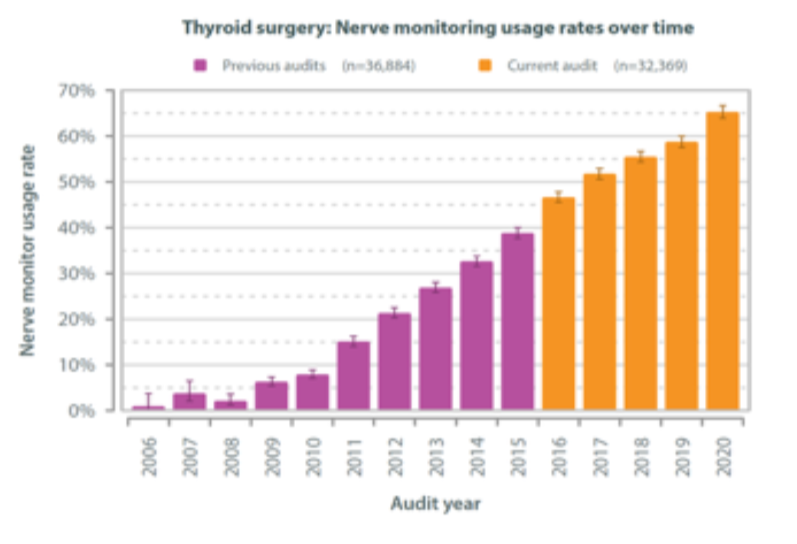
The use of IONM mitigates the risk of RLN injury but the risk remains and sustaining an injury to RLN remains possible even when IONM is correctly used. Furthermore, some patients report voice changes despite having had a normal IONM, the mechanisms of such (subtle) changes being multifactorial. A recent analysis of UKRETS data showed a reduction in the risk of overall and persistent RLN injury and supports its routine use. Using IONM may reduce litigation claims by demonstrating that all precautions were taken with the aim of minimising the risk of negative voice outcomes by reducing nerve injury and its associated negative outcomes. Preoperative discussion with the patients about IONM should highlighting its limitations (e.g. false-positive rates) and its impact on disease management by opting for a staged thyroidectomy if there is loss of signal after dissection of the first side during total thyroidectomy. If on the first side operated there is an injury to RLN with a loss of signal on IONM, a decision has to be made whether to abandon operating on the contralateral side in order to avoid the risk of bilateral nerve injury and subsequent need for tracheostomy.
Where an unexpected intraoperative event changes the risk profile of the procedure, intraoperative decision-making and its documentation may become central to determining whether the subsequent course of surgery was reasonable.
For medico-legal solicitors, the key issue is often not simply whether a recognised complication occurred, but whether the risk was properly assessed, explained, documented and managed. In voice-change claims following thyroid surgery, the records should be reviewed closely for evidence of pre-operative vocal cord assessment where appropriate, clear consent discussions around RLN and SLN injury, identification of patient-specific risk factors, the surgeon’s annual thyroid workload, whether the case was discussed within an MDT where malignancy was suspected, and whether intraoperative nerve monitoring was used and documented. The absence of these details does not automatically establish breach, but it may identify areas where the standard of care requires closer expert scrutiny.
In summary, a surgeon with adequate annual workload, whose work is done within the context of a multidisciplinary meeting, who operates using the intraoperative adjuncts deemed to be beneficial for better outcomes and who has access to timely and effective interventions to address complications is unlikely to have complaints that can be found to be in breach of duty or negligence. Remaining engaged with education activities of professional societies and following the research publications on related topics contribute to maintaining the professional standards expected by patients and society.
Causation also needs careful handling. A poor voice outcome does not, on its own, prove negligent surgery. Solicitors will need expert evidence to distinguish between an unavoidable nerve injury, a technical surgical error, disease-related nerve involvement, intubation-related trauma, and multifactorial post-operative voice change. The timing and persistence of symptoms, post-operative laryngoscopy findings, IONM records, operative notes and any referral for speech and language therapy or ENT review may all be relevant. Early identification of these records can help narrow the issues in dispute, avoid weak allegations, and ensure that instructions to the expert focus on the questions most likely to affect liability and quantum.
Tags:
- Endocrinology Expert Witness
- Endocrinology Negligence
Expert Disciplines:
- Endocrinology
About The Author
Mr Radu Mihai
Consultant Endocrine Surgeon
Mr Radu Mihai has undertaken medico-legal work since 2020. He is a Consultant Endocrine Surgeon and expert witness specialising in clinical negligence matters involving thyroid, parathyroid and adrenal surgery, with particular expertise in post-operative voice changes, laryngeal nerve injury, surgical complications and causation.
From the Blog
Related Articles
Gain vital insights into diagnosing and managing complex paediatric ear conditions, helping clinical negligence solicitors identify breaches, delays, and strengthen case strategy effectively.
Help clients grasp complex clinical negligence issues with clear, expert-backed explanations - empowering solicitors to communicate effectively, manage expectations, and strengthen case outcomes with confidence.
Whether you’re assessing a potential clinical negligence claim or preparing expert evidence, understanding the evolving standards around laparoscopic cholecystectomy is critical. This blog brings together trusted medical, legal, and procedural insights - helping solicitors navigate causation, consent, and surgical error with confidence.
Find out why 70+ legal firms partner with INNEG.
Request a callback, or contact us.
INNEG respects your privacy. Any information you share with us will be used only to respond to your query.
Phone
+44 161 870 2461Thank you for your request!
We will get back to you as soon as possible.