The Medico-Legal Implications of Pressure Ulcers and Chronic Wounds Across Care Environments
By Sylvie Hampton , Independent Tissue Viability and Lymphoedema Nurse
Posted 21 January 2026
9 Minute Read

When pressure ulcers lead to claims, the decisive question is rarely "what happened", but "what can be proven" - explore the clinical realities that shape legal outcomes.
Introduction
Pressure ulcers have only one cause and that is pressure1. There are causative factors, such as incontinence and poor nutrition, but they are not the primary cause. These wounds have legal significance as pressure ulcers and chronic wounds are frequently considered largely preventable or avoidable injuries2 when proper care is delivered. Because of this, they are often interpreted legally as a potential indicator of neglect, system failure, or breach of duty of care3, 4.
They commonly lead to:
- Claims of clinical negligence
- Safeguarding investigations
- Regulatory action
- Inquests (if the wound contributed to death)
- Professional accountability proceedings
The prevention of a pressure injury is simple. Keep people moving and use appropriate equipment5. Repositioning when in bed according to the individual’s need. This can be established by examining the skin over bony prominences and looking for reddening. Any redness is an indication that a pressure ulcer could occur if repositioning is not increased and/or the mattress is not upgraded for a pressure reducing mattress or repositioning equipment6. Also, when in a chair, to stand up 2 to 3 times every hour7. However, this is not always possible dependent on any spinal injury and the person caring for them or the age and condition of the elderly person. Therefore, repositioning every 2 hours, although not ideal, may be all that can be achieved. Also, for all those who have less mobility, it is vital to have a pressure reducing cushion in the seat. Ensuring that the person’s legs are at a 90-degree angle in the chair - this means they are less likely to place the heels on the floor.
Legal duties are owed in all care settings and regardless of environment, providers must demonstrate a duty of care and an established responsibility to protect the patient from avoidable harm8 and a Breach of duty would be considered as a failure to meet accepted clinical standards, such as:
- Not performing a risk assessment (e.g., Waterlow, Braden, etc)
- Not repositioning appropriately or not providing equipment that would automatically reposition
- Inadequate pressure redistribution equipment
- Failure to assess or escalate wound deterioration
- Poor nutrition/hydration management
- Inappropriate or delayed treatment
Pressure ulcers will commence as redness and then will break down into one or two types. A grade or category 1 is unbroken skin with injury under the surface. Grade or category 2 is a break in the skin that is superficial, unlikely to develop further and will heal quickly. The other types are deep damage under the skin, causing a very large wound that can go down to bone. This is Grade 3 and 4 and both of these are dangerous as they become colonised and potentially infected. These are life-threatening conditions and everything must be done in order to prevent9. Once established they take a great deal of time and effort to heal10.
A foam mattress or cushion may be adequate for the individual but if they develop redness over the ischials then the cushion is not adequate or, if over the sacrum or hips, the mattress is inadequate. Redness over the heels can be from the bed or from the floor is someone sits with heels out in front of them and particularly if ankles are crossed. Heels should always be protected as there is not a mattress in the world that can prevent heel ulcers due to the poor blood supply, thin skin and bony prominence.
The Department of Health have defined avoidable pressure ulcers11 as:
“Avoidable” means that the person receiving care developed a pressure ulcer and the provider of care did not do one of the following: evaluate the person’s clinical condition and pressure ulcer risk factors; plan and implement interventions that are consistent with the persons needs and goals, and recognised standards of practice; monitor and evaluate the impact of the interventions; or revise the interventions as appropriate.”
“Unavoidable” means that the person receiving care developed a pressure ulcer even though the provider of the care had evaluated the person’s clinical condition and pressure ulcer risk factors; planned and implemented interventions that are consistent with the persons needs and goals; and recognised standards of practice; monitored and evaluated the impact of the interventions; and revised the approaches as appropriate; or the individual person refused to adhere to prevention strategies in spite of education of the consequences of non-adherence”
A key study12 found that when sitting naturally only a small amount of pressure for one to two hours could lead to the development of a pressure ulcer as body weight in this position, is redistributed over a smaller area resulting in high pressures in the buttocks13. This extra pressure upsets the blood flow through the skin starving the area of oxygen and nutrients, and if this goes unrelieved begins to breakdown, leading to the development of a pressure ulcer.
Therefore, whether this pressure ulcer was avoidable or not will be judged against the definition of the Department of Health and will be based on a >51% possibility that the pressure ulcer could, or could not, have been avoided.
It is estimated that it could take 3-10 days from the initial insult causing the damage, to become a Stage III or IV Pressure Ulcer14.
Deterioration can occur despite appropriate care such as:
- Patient declined care and refusal was documented and alternative care was offered
- Skin failure due to terminal physiological decline such as end-of-life skin failure
- If the documentation demonstrates this was the reason for the skin changes, then it would be deemed unavoidable. However, the legal defence depends entirely on evidence and if the care was not recorded then it was not provided. This can feel deeply unfair, especially when families and even clinicians believe the care was delivered, but the proof is missing. In those situations:
- The patient may have genuinely received good care
- Staff may have worked hard under difficult conditions
- The deterioration may truly have been clinically unavoidable
Yet, without written evidence, photos, charts, or escalation records, there is no legal defence, and the wound is interpreted as a failure to prevent harm. It becomes unfair not because the law is harsh, but because the patient’s suffering is real, and the system must find accountability somewhere.
Documentation failures are the leading cause of legal vulnerability and the courts and regulators rely heavily on well kept records15. Common documentation breaches include:
- No risk assessment or reassessment
- Care plan present but not implemented
- No repositioning charts or incomplete charts
- No equipment prescription or delay rationale
- No escalation records (SBAR, referrals, photos, wound measurements)
- No nutrition screening (MUST) or dietetic referral when indicated
- No capacity or best-interest decision record when patients refuse care
- No evidence of patient/family communication or shared decision-making
Legally: if it is not documented it is not done.
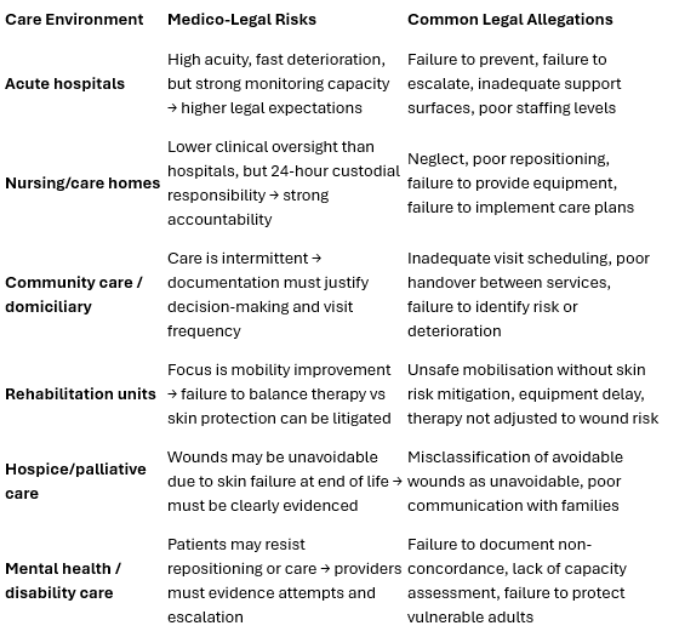
Also, standards of care may vary according to the site of the care but expectations remain constant as follows:
Conclusion
Pressure ulcers and chronic wounds carry medico-legal weight not because they occur, but because of the question: ‘What was done in order to prevent?’ When documentation clearly evidences the clinical rationale for skin deterioration and demonstrates that all appropriate preventive and therapeutic measures were implemented, the wound may be classified as unavoidable. However, defensibility relies entirely on recorded evidence. In the absence of documentation, even wounds that may have been clinically unavoidable are typically interpreted as avoidable harm. This is profoundly sad, as it can unintentionally misrepresent the reality of care delivered, and risks obscuring the true issue which is often system failure rather than individual intent.
References
1.Thomas DR. Does pressure cause pressure ulcers? An inquiry into the etiology of pressure ulcers. J Am Med Dir Assoc. 2010 Jul;11(6):397-405.
2.Bhattacharya S, Mishra RK. Pressure ulcers: Current understanding and newer modalities of treatment. Indian J Plast Surg. 2015 Jan-Apr;48(1):4-16.
3.Lyder CH, Ayello EA. Pressure Ulcers: A Patient Safety Issue. In: Hughes RG, editor. Patient Safety and Quality: An Evidence-Based Handbook for Nurses. Rockville (MD): Agency for Healthcare Research and Quality (US); 2008 Apr. Chapter 12. Available from: https://www.ncbi.nlm.nih.gov/books/NBK2650/
4.Lockhart, D. The Legal Implications of Pressure Ulcers in Acute Care. Critical Care Nursing Quarterly. 2002 25(1):63-68
5.Hommel A, Santy-Tomlinson J. Pressure Injury Prevention and Wound Management. 2018 Jun 16. In: Hertz K, Santy-Tomlinson J, editors. Fragility Fracture Nursing: Holistic Care and Management of the Orthogeriatric Patient [Internet]. Cham (CH): Springer; 2018. Chapter 7. Available from: https://www.ncbi.nlm.nih.gov/books/NBK543831/ doi:10.1007/978-3-319-76681-2_7
6.Collier M, Jones S, Glendewar G. Pressure ulcer prevention, patient positioning and protective equipment. Br J Nurs. 2023 Feb 9;32(3):108-116.
7.Schofield R, Porter-Armstrong A, Stinson M. Reviewing the literature on the effectiveness of pressure relieving movements. Nurs Res Pract 2013: 124095
8.https://www.rcn.org.uk/Get-Help/RCN-advice/duty-of-care
9.Zaidi SRH, Sharma S. Pressure Ulcer. [Updated 2024 Jan 3]. In: StatPearls [Internet]. Treasure Island (FL): StatPearls Publishing; 2025 Jan-. Available from: https://www.ncbi.nlm.nih.gov/books/NBK553107/
10.InformedHealth.org [Internet]. Cologne, Germany: Institute for Quality and Efficiency in Health Care (IQWiG); 2006-. Overview: Pressure ulcers. [Updated 2022 Aug 19]. Available from: https://www.ncbi.nlm.nih.gov/books/NBK326428/
11.Greenwood, C., Eliminating avoidable pressure ulcers: NICE quality standard 89. Wound Essentials, 2015. 10(2): p. 43-46
12.Kosiak, M. Etiology and pathology of ischemic ulcers. Arch Phys Med Rehabil, 1959 40(2) pp. 62-69
13.J.C. Barbanel. Pressure management. Prosthetics Orthot Int, 15 (1991), pp. 225-231
14.Data extracted from NIMS on 13/4/22. The National Incident Management System (NIMS) is a dynamic system and is the key platform for HSE and HSE-funded healthcare providers to report incidents on. Additionally, the NIMS system is the source of data in terms of incident management as a quality indicator and is also used to inform the National Service Plan KPIs. More information is available at: https://www.hse.ie/eng/about/who/nqpsd/qps-incident-management/nims/national-incidentmanagement-system-nims-.html or NIMS helpdesk at nims@hse.ie)
15.Andersson J, Imberg S, Rosengren K. Documentation of pressure ulcers in medical records at an internal medicine ward in university hospital in western Sweden. Nurs Open. 2023 Mar;10(3):1794-1802.
Tags:
- Ulcer
- Pressure Injuries
- Scar Management
- Clinical Notes
- Expert Panel
Expert Disciplines:
- Nursing
About The Author

Sylvie Hampton
Independent Tissue Viability and Lymphoedema Nurse
Sylvie Hampton is a Tissue Viability Consultant Nurse and Expert Witness with 25 years’ medico-legal reporting experience, having prepared reports since 2001. She undertakes around 15-20 reports per year, predominantly for Claimants, and has experience preparing joint statements and giving evidence at trial.
Her specialist expertise includes pressure ulcers, chronic wounds, tissue viability, wound care, falls and nursing care, making her particularly suited to Clinical Negligence instructions involving pressure damage, wound management and standards of nursing care.
From the Blog
Related Articles

Pressure ulcers - also known as pressure injuries or bedsores - are widely recognised as a barometer of care quality in health and social care settings.

When a high-risk patient requests PSA testing and is declined based on national guidance, the legal stakes can be high. This case explores the fine line between following protocol and breaching duty of care.
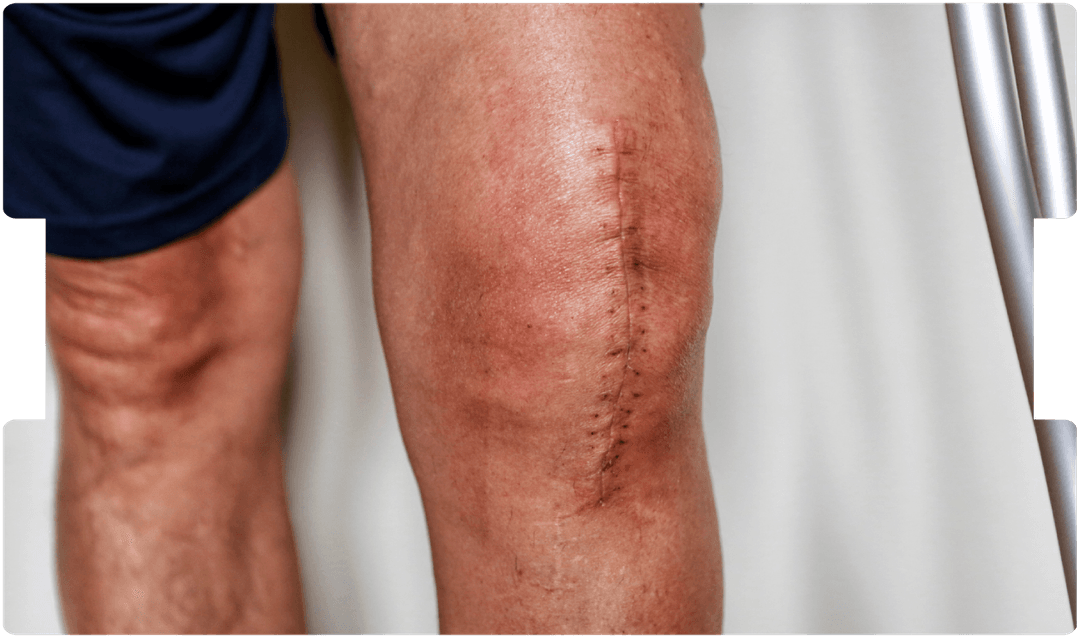
Scarring and disfigurement remain some of the most complex elements of personal injury and clinical negligence litigation, influencing causation, prognosis, psychological outcome, and long-term quantum.
Find out why 70+ legal firms partner with INNEG.
Request a callback, or contact us.
INNEG respects your privacy. Any information you share with us will be used only to respond to your query.
Phone
+44 161 870 2461Thank you for your request!
We will get back to you as soon as possible.